
How a Railroad Man Invented Hospitality in the Wild
In today’s world of readily accessible travel connecting all corners of the globe, it’s hard to imagine the western United States as a distant and wild land that only the most intrepid travelers might see. Now, of course, it’s relatively easy to jump on a plane and find yourself in an exciting new place just a few hours later. But this was certainly not the case in the late 19th century when the Wild West was reserved for hardy souls willing to endure days of grueling travel to reach these storied lands.
As the railroads expanded west, train travel became more common and gave people a direct line to once-inaccessible places like the Grand Canyon. But the journey was difficult, with hard wooden benches, overcrowded coaches, untold delays and a lack of any amenities. It remained a long and arduous journey.
Until a visionary entrepreneur named Fred Harvey had an idea that would change tourism in the west forever. Born in London, in 1835, Harvey arrived in the United States at age 18, eventually settling in St. Louis, Missouri. In a few short years, he would endure hardships including typhoid fever, the loss of his entire life savings, the start of the Civil War, and the death of his first wife in childbirth. Looking for a new start, he remarried, moved his family to Leavenworth, Kansas and began working as a sales agent for the railroads.
But Fred Harvey had bigger plans. Recognizing opportunity within the railroad travel industry, he made a handshake deal with the Santa Fe Railway to open an “eating house” in Topeka, Kansas, along the route to California. This first Harvey House, opened in 1876, was an instant success and raised the bar for train travel across the country. An innovative telegraph system would alert the restaurant ahead of the train’s arrival, making it possible to feed hundreds of passengers high-quality food in a short period of time. Adding a new level of comfort and class to the train journey, it became the first piece in his budding hospitality empire.
As the Santa Fe Railway continued to lay tracks west, Harvey would open new establishments in step. When the railroad reached New Mexico in 1881 he opened two more restaurants, El Ortiz in Lamy and Castaneda in Las Vegas. The Alvarado would follow at Albuquerque. And then, in 1883 at the Harvey House in Raton, New Mexico, his next great idea would take center stage: The Harvey Girls.
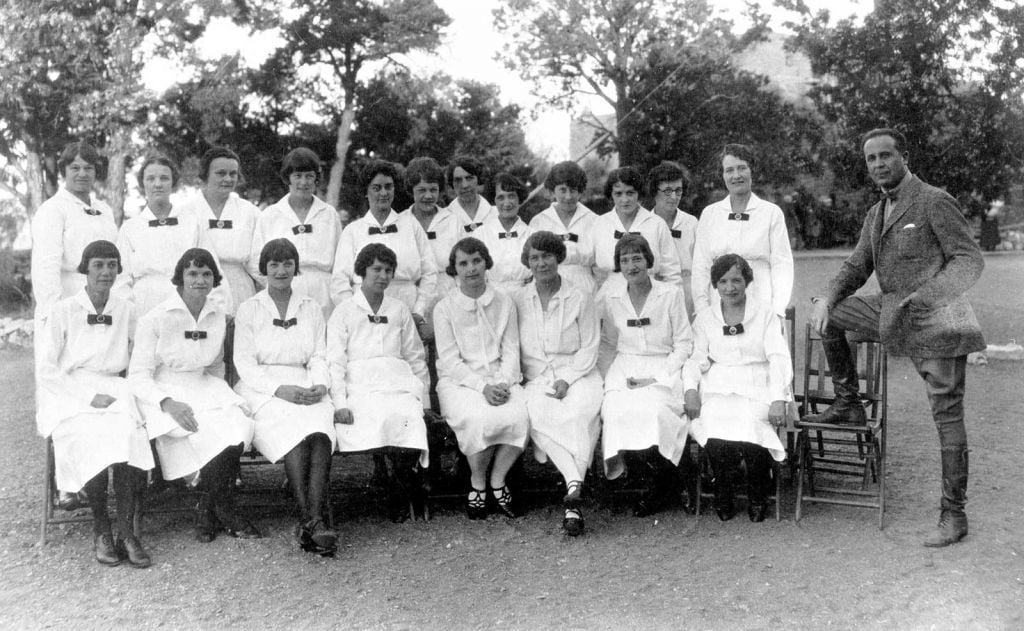
Harvey began to recruit single young women “of good moral character, attractive and intelligent,” who were able to venture into unknown territories and work as waitresses in his restaurants. The typical Harvey Girl uniform consisted of a long black dress (no more than eight inches off the floor) with black stockings, black shoes, and a starched white apron. The Harvey Girls added a touch of graciousness and hospitality to these rugged lands, making the experience more enjoyable for travelers.
Over time, the Fred Harvey Company employed around 100,000 Harvey Girls. Although they were forbidden to fraternize with guests, it’s estimated that 20,000 of them would lay down roots, getting married to local customers, and ultimately be credited with helping to civilize the American Southwest.
Expanding Empire
Over the next several years, Harvey continued building at a rapid pace. As the railway reached the west coast, Harvey added more restaurants, hotels and gift shops. By 1891, he had opened 15 Harvey House restaurants and hotels across the southwest, each with its own unique identity tied to the location. And all staffed with the now iconic Harvey Girls.
With the introduction of luxury railcars bringing well-heeled tourists across the country, Harvey adapted to create his own dining cars, allowing travelers to enjoy good meals and relaxation on board, along the way.
He also began to introduce travelers to Native American culture, hiring regional artisans to create and sell mementos at his properties. Fine Native American crafts became a hallmark of his shops, and the company hired artists and photographers to convey the “exotic” Native Americans of the southwestern tribes. The company went on to employ Native Americans to demonstrate traditional rug weaving, pottery and jewelry making at his hotels across the region.
By the time of his death in 1901, Fred Harvey had built a bona fide tourism empire with 47 restaurants, 15 hotels and 30 dining cars on the Santa Fe Railway. Establishing himself as the founding father of the American hospitality industry and a pioneer of cultural tourism.
After his passing, Harvey’s sons Ford and Byron continued to operate and grow the family business, soon embarking on perhaps the company’s most significant and enduring outposts at the Grand Canyon.
Harvey and Grand Canyon National Park
When the railroad completed a line north from Williams, Arizona to the South Rim of the Grand Canyon, tourists began to arrive en masse. The Fred Harvey Company was well poised to take advantage of the influx. With the Fray Marcos hotel and restaurant already established in Williams, the company went on to become the first official concessionaire with several new hotels and restaurants at the canyon when it was declared a national park in 1919.
In a further nod to regional heritage and history, the Harvey Company commissioned noted architect Mary Colter to design many of their new buildings at the new National Park. Built to reflect the natural setting, and utilizing components found in Native American architecture of the time, Colter would design many legendary hotels still in operation today. These include the Bright Angel Lodge, Desert View Watchtower, Phantom Ranch, Hopi House, and more.
Together, Colter and the Harvey family laid the foundation for tourism at Grand Canyon National Park. A legacy that lives on to this day.
Changing Times Changing Tastes
Over the coming decades, the Fred Harvey Company continued to expand and evolve with the times. Despite two World Wars and the Great Depression, the family business added new properties and innovative tourist operations. With the establishment of Route 66 through the region, the company began catering to automobile travel and placing hotels and restaurants in new areas, along the highways and away from the railroad tracks.
The Harvey Girls became a cultural icon in their own right. So much so that they were featured in a Hollywood musical aptly named “The Harvey Girls” starring Judy Garland in 1946. At its peak, the Fred Harvey Company would operate more than 80 establishments and continue to thrive for many years to come.
Fast forward to 1968. After three generations of ownership, the Fred Harvey Company sells the business, merging with Amfac Parks & Resorts, which would ultimately become Xanterra Parks and Resorts in 2002. Xanterra then acquired the Grand Canyon Railway in 2007 and, to this day, remains the primary purveyor of lodging, dining, retail and tours on the South Rim of the Grand Canyon.
Now known as Xanterra Tavel Collection®, the company proudly celebrates its 150th anniversary this year, thanks to the pioneering vision of Fred Harvey and his first humble Harvey House hotel, opened in 1876 along the railroad tracks in Topeka, Kansas.
For more information about Xanterra Travel Collection® and its affiliate properties, visit Xanterra.com/stories.
The post Fred Harvey’s Grand Vision first appeared on Grand Canyon.